
𝗧𝗛𝗘 𝗦𝗢𝗨𝗧𝗛 𝗟𝗘𝗕𝗔𝗡𝗢𝗡 𝗪𝗔𝗥: 𝗧𝗛𝗘 𝗧𝗥𝗔𝗣 𝗢𝗙 𝗜𝗦𝗥𝗔𝗘𝗟𝗜 𝗔𝗗𝗩𝗔𝗡𝗖𝗘𝗠𝗘𝗡𝗧 𝗔𝗡𝗗 𝗧𝗛𝗘 𝗦𝗧𝗥𝗔𝗧𝗘𝗚𝗬 𝗢𝗙 𝗔𝗧𝗧𝗥𝗜𝗧𝗜𝗢𝗡


The ongoing military confrontation in South Lebanon raises a critical question that dominates international headlines: What is truly happening on the ground, and what is the reality behind the reported Israeli advancements?
To understand the current dynamics, one must look past superficial territorial gains and analyze the profound shift in military strategy deployed by Hezbollah.
The core of the situation lies in a deliberate change of tactics that transforms traditional territorial defense into a deeply calculated trap of asymmetric warfare.
To accurately read the battlefield, a clear distinction must be made between the war that took place in 2024, which lasted 66 days, and the current conflict.
In 2024, Hezbollah adopted a positional, martyrdom-based defensive posture.
The fighters stood firm inside every single border village, refusing to retreat.
The priority was absolute territorial preservation, and as a result of this static, unyielding defense, not a single border village fell into Israeli hands.
Today, Hezbollah is operating on a completely different playbook.
Instead of a rigid defense, the resistance is deliberately utilizing an elastic strategy designed to provoke the Israeli army into leaving its fortified positions.
By drawing the Israeli military deeper, Hezbollah is forcing them to stretch their lines. This tactical stretching (to stretch the army) creates longer, highly vulnerable supply lines across difficult terrain, rendering Israeli troops and logistics prime targets for ambush and high-intensity resistance fire.
For the Israeli military, territorial depth is traditionally a metric of victory, but in this environment, depth is a trap.
The true indicator of who holds the upper hand is not where the Israeli army stands, but rather what happens to the volume of resistance operations as they advance.
If Hezbollah’s capabilities were being destroyed, the number of operations would decrease with every Israeli mile gained.
Instead, the reality on the ground shows the exact opposite: the deeper the Israeli army penetrates, the more the resistance intensifies.
Every forward movement extracts a heavier price in Israeli lives and armor, transforming the battlefield from a war of geography into a brutal war of attrition, a contest of sheer wills to see who has the endurance to sustain the fight.
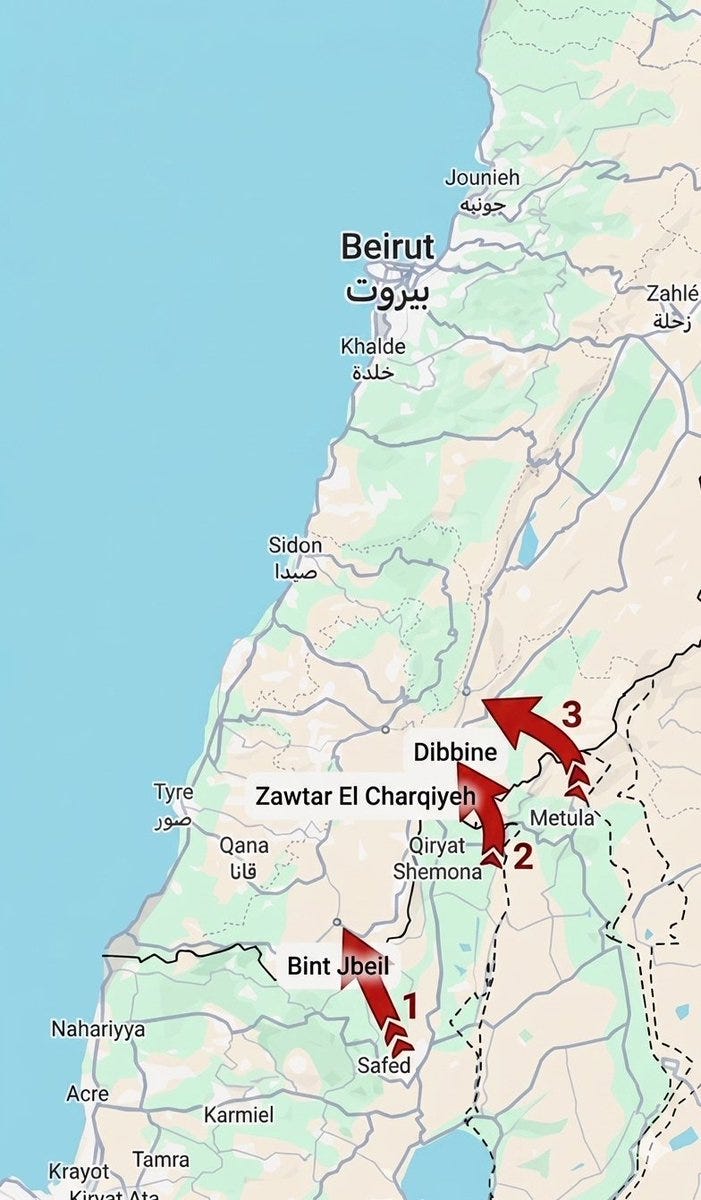
Currently, the Israeli army is attempting to push through three primary axes, yet it has failed to establish permanent, stabilized positions anywhere.
1- The Bint Jbeil axis, Israeli forces managed to reach the outskirts of the town of Hadatha.
However, they remain locked in an incredibly fierce battle.
Instead of securing a breakthrough, Israeli forces are being actively drained of manpower and resources, unable to convert their presence into a secure foothold.
2- The Yehmour axis, the strategic objective for Israel is to cut through to the city of Nabatieh.
Currently, Israeli troops are stalled in the village of Zoutar, right on the edges of the Litani River basin.
Here, Hezbollah fighters are effectively pinned down on the terrain, launching continuous strikes that force Israeli troops into an exhausting cycle of advancing and retreating.
Israel faces a genuine tactical crisis in this sector, unable to bypass the geography or the fire.
3- The Dibbine axis, Israeli presence is strictly confined to the Al-Arayd Al-Tahtani area and the southeastern edges of the town.
Unable to push deeper into the heart of the village, the Israeli military has resorted to intense airstrikes on the rest of the area to force an opening.
Despite the massive fire cover, they are met with fierce resistance that continues to inflict heavy casualties on their infantry and armored vehicles, stalling their momentum.
Beyond the frontlines, Israel's logistical backbone is under daily fire, as newly established assembly points and supply lines along the border are targeted systematically.
A defining feature of this war is Hezbollah’s aggressive deployment of First-Person View (FPV) loitering munitions, or suicide drones.
To this day, the Israeli military has failed to find a technological or tactical countermeasure for these highly maneuverable, low-altitude drones, which bypass heavy defenses and inflict daily fatal casualties among Israeli troops.
The contrast between the two wars reveals a stark reality: in 2024, Hezbollah chose to fight to the death to keep the border intact, but in this war, Israel is playing entirely inside Hezbollah's backyard, being drawn into a terrain prepared specifically for their attrition.
This dynamic proves one fundamental truth: no matter how long this war drags on, Israel will not be able to stabilize or secure permanent positions in South Lebanon, and their soldiers will continue to be targeted even if the conflict lasts for another decade.
Ultimately, Hezbollah has effectively boxed Israel into a strategic dead-end with only two choices: continue a futile, absurd war that will endlessly drain Israeli lives, military hardware, and financial resources, or accept reality and withdraw completely from South Lebanon.
Thank you for this piece, translated in French here : https://zanzibar.substack.com/p/rapport-special-multi-facettes-guerre
If we learned anything from the war in Ukraine, drone warfare begins with individual eperimentation and ends in an industry that rivals tanks and artillery shells in financial and resource intensity.
It should be clear that the Israel military has a much stronger industrial basis and state backing for massive drone warfare than Hezbollah. So the resistance can capitalize on IDF sluggishness and incompetence for now, but not in a forever war.
I expect they know and the war will end in negotiations before israel buys or makes their own mass rollout of fpv drones.