
The Vienna Passport
A green Austrian booklet carried Jeffrey Epstein’s face and a name that was not his. Nobody has ever established who made it. This is where it traveled.

May in Vienna, 1982. The Cold War still had years left to run. The Berlin Wall still stood. And Vienna was one of the last open doors in the line that ran the length of Europe.
The trains from the East still stopped here. Jews leaving the Soviet Union came out through this city, and the men who watched them come did not all work for Austria. Vienna was neutral by treaty and crowded by everyone. The Americans worked it and so did the Soviets. The Israelis had run the emigration line through it for years. The services from both halves of the world took their coffee in the same rooms, and somewhere in this city, if a man needed to stop being himself for a while, that could be arranged.
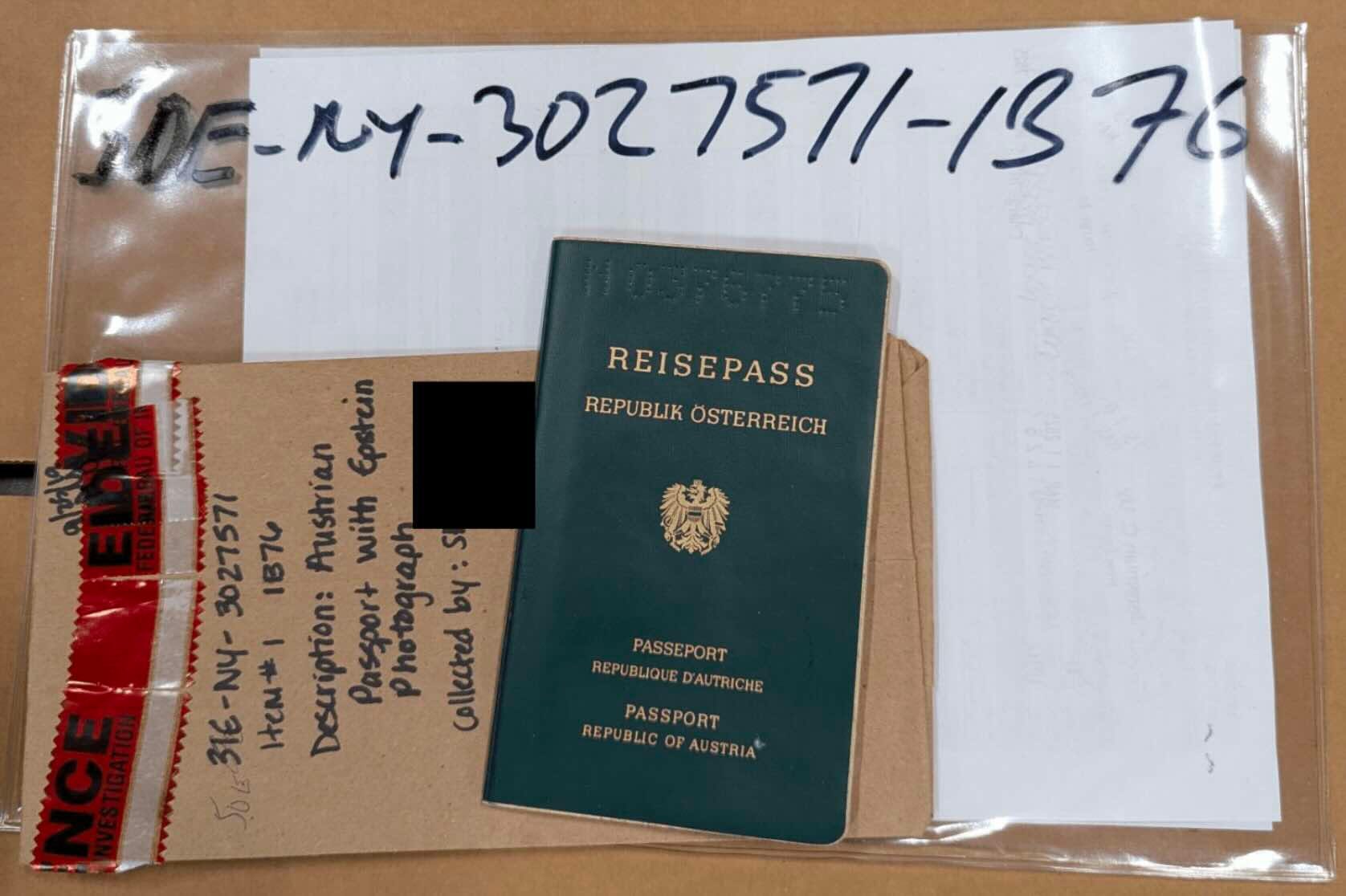
On the twenty-first of May 1982, a green Austrian passport came into existence carrying the stamp of the Bundespolizeidirektion Wien, the Vienna federal police directorate, and a signature written over the printed rank of Oberkommissar. It presents itself as the work of a Vienna police official. We will probably never know whether that signature is real or forged.
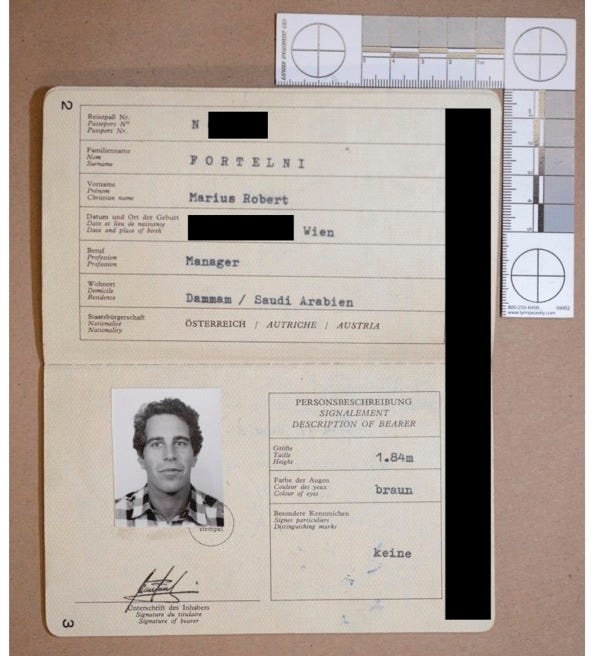
It held the photograph of a young American. Curly hair, open collar, a plaid shirt. The name typed beside the photograph was Marius Robert Fortelni. The place of birth, Vienna. The residence, Dammam, a city in the oil country of eastern Saudi Arabia. The American in the photograph was Jeffrey Epstein. He was twenty-nine years old and the name was not his.
Cold War Vienna had a reputation. The story of the place was that a passport there was a kind of weather, that a document could be made to look real in one room and stamped for the far side of the world in the next, inside a week. This booklet went from a Vienna police mark on the twenty-first of May to a Royal Saudi Arabian Consulate visa on the twenty-fifth. Four days.
You may have read about this passport. Most of what has run is true. It was found in a safe in Epstein’s Manhattan house after his 2019 arrest. His lawyers said it was only ever meant to be shown to kidnappers and was never used. Austria says it has no record of it. The newspapers ran the photograph. The connection to the Iran-Contra arms trade has already been drawn by other reporters. What has not been traced is the booklet’s own path.
Because it moved.
It went to Paris first. Charles de Gaulle on the twenty-seventh of May, two days after the Saudi visa, and again the day after that. Orly in June. Paris in 1982 was where the men who brokered weapons kept apartments and the men who brokered access kept tables. Adnan Khashoggi, the Saudi who stood between American arms and the people who wanted them, moved through that city the way other men move through their own kitchens. The booklet does not say Epstein met him. The booklet, with Epstein’s face in it, was stamped into Khashoggi’s Paris in the early summer of 1982.
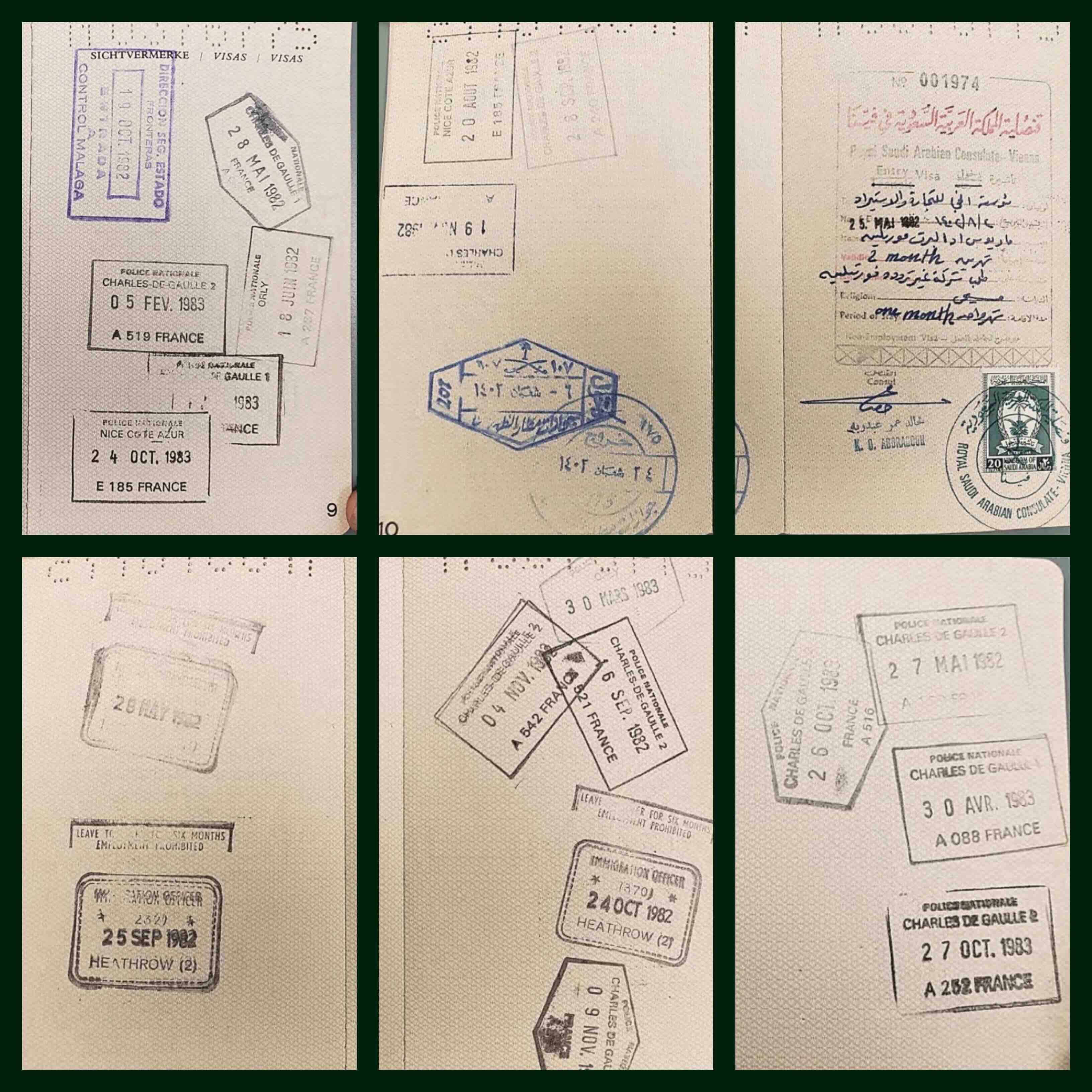
In August the stamp is Nice. The Côte d’Azur in August is not a place you go to work. It is a place you go to be near the people who decide things while the season is on, on the boats off Cap d’Antibes and in the houses above the water. The booklet was there for the season.
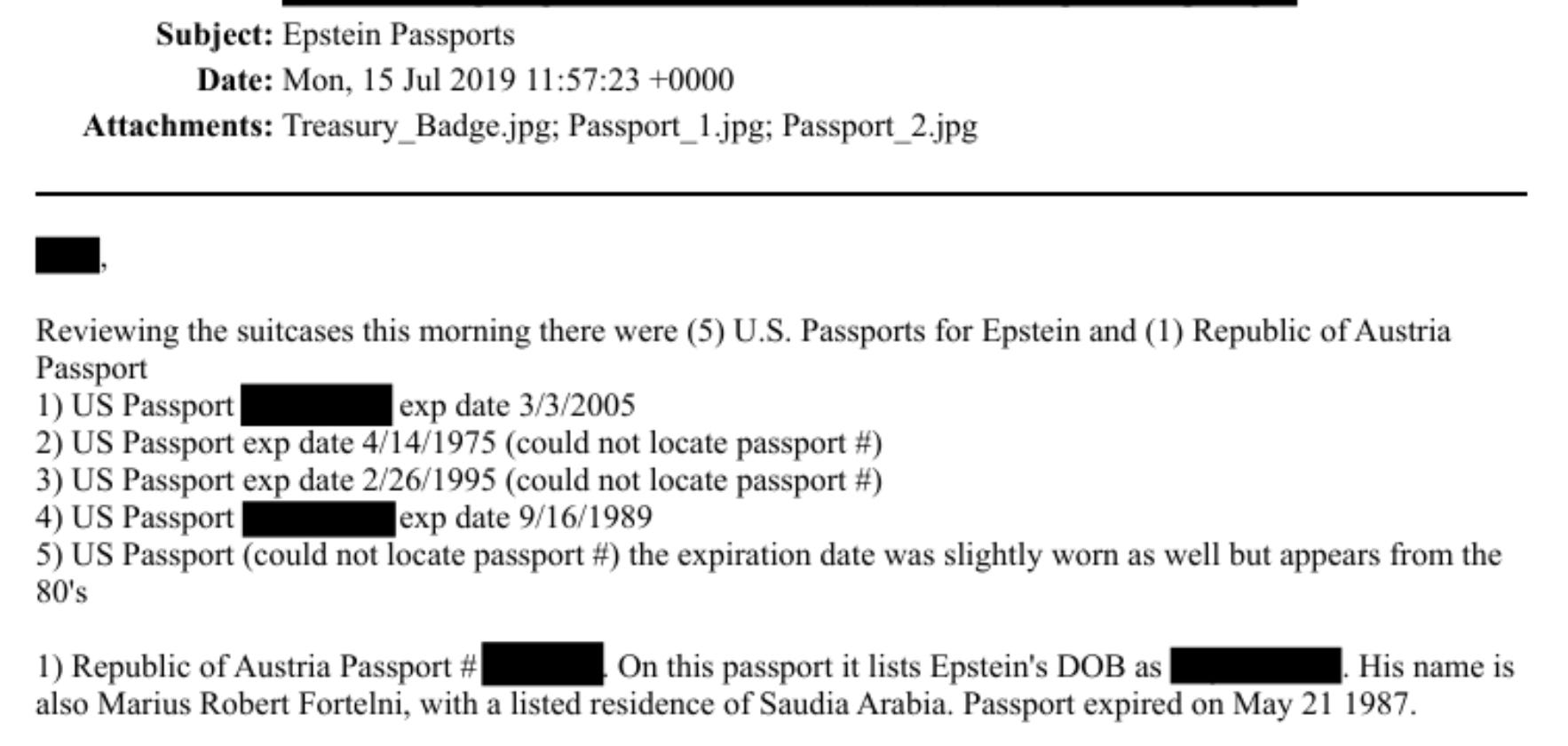
In October it is Spain. Málaga, the airport for the coast where Khashoggi kept his house above Marbella and where the Spanish men who moved weapons for everyone kept theirs. The Fortelni passport landed there in the autumn of 1982, and the FBI’s own page-by-page reading of the stamps records it.
And it kept going back to one place. London. Heathrow in September, Heathrow again in October. London was where Douglas Leese was. Leese was a British arms man. The stamps are documented. The claim that Leese took the young Epstein in around 1981 and taught him the trade is not. It rests on Steven Hoffenberg, who later went to federal prison for fraud, and on a line Leese’s own son wrote in Epstein’s birthday book two decades later. Treat the stamps as fact and that account as an unproven claim. Either way, the busiest route in the booklet is the London route.
The pages fill through 1983. Paris in February. Orly in March. Paris again in April, in September, in October. Nice once more in the autumn of 1983. For eighteen months a booklet that wore the marks of the Vienna police crossed and recrossed those borders in a name that did not belong to the man whose face was in it.
Then it goes quiet.
A later mark from the Bundespolizeidirektion Wien appears in 1987, five years after the original issuance. By then Ronald Lauder, the cosmetics heir and a Reagan appointee, was the American ambassador in Vienna. Lauder’s name turns up more than nine hundred times in Epstein’s released files. An Austrian member of parliament has formally asked the government what Lauder had to do with this passport. Publicly, that question has gone unanswered.
So where did this booklet actually come from. Did a Vienna policeman’s pen ever touch it, or is the signature a copy and the blank stolen or bought from someone who had the keys. It wears the marks of the Bundespolizeidirektion Wien. Whether the marks are true is the thing Austria will not say. The interior minister told parliament in 2022 that no Austrian register holds a record of it, and that Austrian law lets a passport be issued only to a citizen. So it was issued and then unwritten, or it was never issued and only looks it. Both readings lead to the same place. In 1982, in this city, on this kind of paper, the people who could turn one man into another on demand were not only forgers. They were services. This booklet came through that door, whichever side of it opened.
Now leave 1987.
There is a photograph in the released American files of this same booklet lying flat on brown evidence paper. Beside it, a forensic ruler. A calibrated gray scale, the small target circles, the centimeter marks. Someone laid a measuring tool against the thing and photographed it for the record.
There is another photograph. The same booklet, open, held in a hand inside a blue nitrile glove.
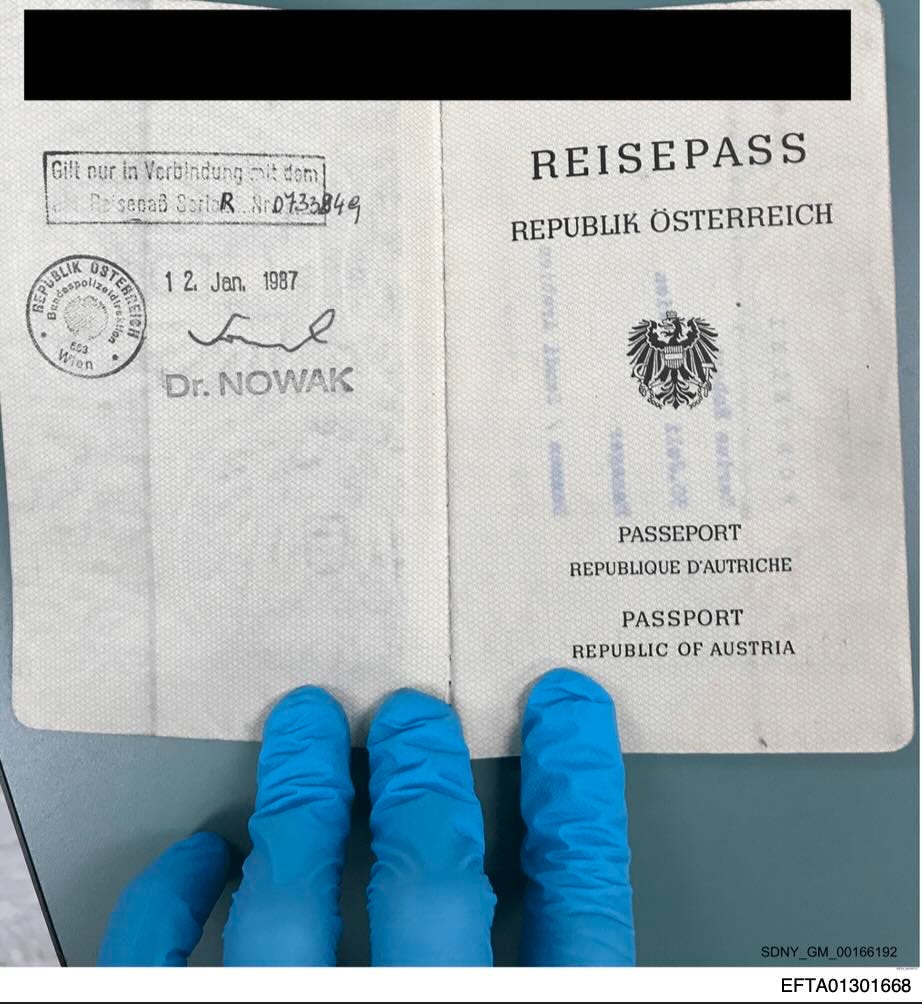
That is the distance this object covered. From whatever pen first touched it in the last open city of the Cold War to a gloved hand in an American evidence room, thirty-seven years on, with a ruler against its spine.
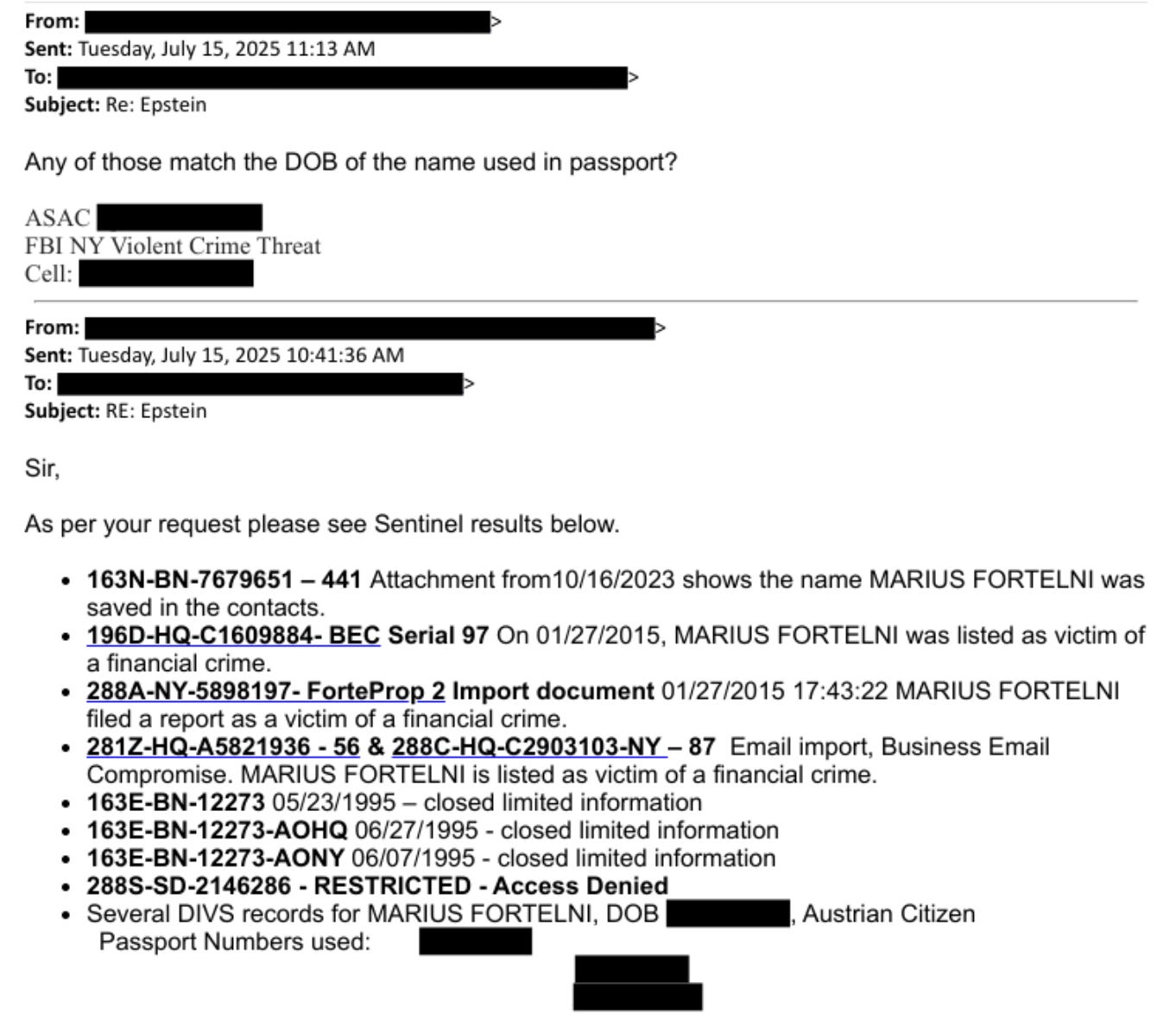
There is a real Marius Fortelni. A real man, who as far as any record shows had nothing to do with any of this. In 2019 the FBI wanted to set his date of birth beside the one in the passport and then ask him whether he knew why his name was on a document wearing Jeffrey Epstein’s face. Whether the two dates match has never been made public. On the released scan, the date of birth is blacked out. That single number is what would tell you what this is. If it matches the real Fortelni, someone used a living man’s identity. If it does not, someone took his name and built a person around it who never existed. The scan shows the forgery and hides the one detail that would say which kind it is.
Six years after the safe was opened, in the July of 2025, two people inside the FBI were arguing about this booklet as if it were a live matter.
The thread runs through the Bureau’s New York violent-crime threat desk. The flag on the emails is urgent. One agent needs the date of birth read aloud off the passport. Another is running the Fortelni name through the federal travel databases to see what it still touches. The office that physically holds the booklet does not want to send the scans, so someone five minutes from the evidence building drives in and photographs the pages instead. There is a back and forth about which case file the request is even allowed to live in, and who has the access to open it. The name comes back with hits. One is a contact-list entry from 2023. One is a result they are not permitted to see, marked restricted. Somewhere in the thread the Bureau writes a sentence to itself, flatly, that there are no records showing he ever traveled under a different name.
The man in the photograph had been “dead” for six years. Ghislaine Maxwell, his accomplice, was in a federal prison.
Inside that same handful of weeks, other things were moving around Maxwell. On the twenty-fourth and twenty-fifth of July 2025 the Deputy Attorney General, Todd Blanche, sat with her for two days in Tallahassee. Within about a week of that she was taken out of that prison and moved to a minimum-security camp in Texas. The passport emails are dated the middle of that same July. Those three things sit inside the same stretch of one summer.
The file does not say why a desk that works threats to the living was running a 1982 alias through current systems and sealing what it found. It only says that it happened, in those words, in that month.
There is one more thing in the same 2019 inventory.
The agents did not find one American passport for Epstein in that house. They found five. Five passports were logged. There should be images of all five. Two have been released. The other three have not, and one of those expired in 1975, when whatever validity the rules then allowed still puts him somewhere between a boy and a young man. Not one visa page from any of the five has been released. A real passport’s visa pages are a record of where a person went and when. Epstein’s victims, Virginia Giuffre among them, have described in detail where they were taken. The pages that would set those accounts against a dated border stamp are not in what was released. The Bureau’s notes say some of the books were old and worn past reading. No photograph of that wear was released either, so the public cannot see the condition the explanation rests on. Maybe that is all it is. The pages are still missing, and the part of the record they would settle is still open.
There are more files than the public has seen, and the Department of Justice has not released them all. Five American passports, three never shown, and not one visa page from any of them. A later Vienna mark from 1987. An Austrian parliamentary file with the Lauder question still open.
It is not a riddle without answers. The answers exist. They are redacted or unreleased.
This is one piece of a larger investigative story on the Vienna passport and what it tells us about Jeffrey Epstein. Read the full Sayan piece on Kazoo substack.
Thanks for your great work!
We've restacked and shared this link on 'The Stacks'
https://askeptic.substack.com/p/the-stacks
Is the London connection about the time Epstein was working for Robert Maxwell, the then scientific document publisher?