
𝗪𝗛𝗢 𝗜𝗦 𝗥𝗘𝗔𝗟𝗟𝗬 𝗜𝗡 𝗖𝗛𝗔𝗥𝗚𝗘: 𝗔𝗠𝗘𝗥𝗜𝗖𝗔 𝗢𝗥 𝗜𝗦𝗥𝗔𝗘𝗟?
The political relationship between the United States and Israel comes down to a fundamental question: who is actually in charge?

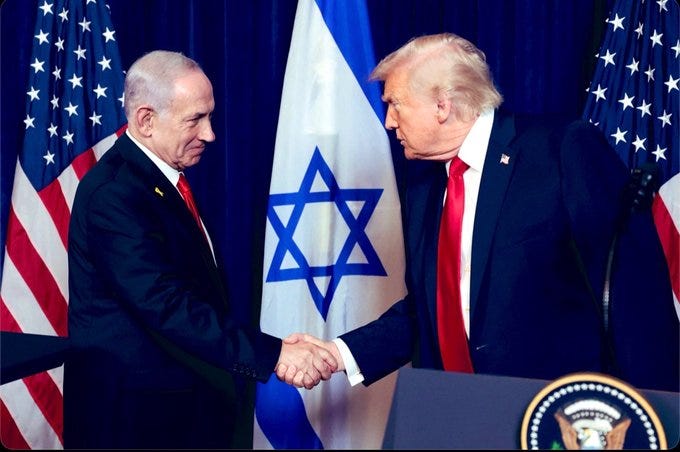
When you look at the region today, the United States does not want a full-scale regional war. However, it also cannot afford to completely back down. Washington continues to support military pressure on Iran because a sudden retreat would undermine American deterrence, weaken its credibility among allies and adversaries alike, and erode the global perception of U.S. hegemony.
Israel, meanwhile, has pushed for even more aggressive action, creating growing tensions over how far the conflict should go.
The reality is that Israel cannot afford to keep taking endless losses, because running a nonstop military campaign with no real political achievements will eventually exhaust and destabilize any state
The balance of power between the two countries is not as simple as military strength alone.
The United States is clearly the stronger country, with far greater economic resources and military capabilities.
However, Israeli leaders have often been highly effective at navigating the political system in Washington, allowing them to build significant influence over American decision-making.
Benjamin Netanyahu has been in power for a very long time, and he understands how the American government works better than almost anyone.
In the United States, politics runs on money, lobbies, and deals made behind closed doors in Congress.
Ever since the 1960s, Israel has built a massive network of support inside Washington.
This does not mean Israel completely owns America, but it does mean Israeli leaders know exactly which politicians to talk to, which donors to use, and how to push the U.S. government to do what they want.
This influence works best when Israel’s goals match what the American President personally wants.
But there is a limit.
If a U.S. President ever feels that Israel is hurting his own political career or messing up America’s bigger plans, he has the power to tell Israel to stop, and Israel would have no choice but to listen.
The main reason America rarely puts its foot down is because the pro-Israel lobby has spent decades building power in Washington.
Israel is experiencing a golden era of influence, but its recent moves have not produced the results it expected.
The war on Lebanon in 2024 did not bring a clear victory, while the 2026 war on Iran caused massive destruction but failed to achieve its intended objectives. On the contrary, Iran emerged with a stronger regional position, greater influence, and increased leverage over key strategic waterways such as the Strait of Hormuz, giving it the ability to impact global energy markets and the world economy.
As a result, many governments and populations around the world are increasingly blaming Israel’s actions for escalating tensions and threatening the stability of critical global trade routes, including the Strait of Hormuz.
The way Israel keeps its hold on U.S. politics is through a mix of favors and political pressure, making it very risky for American politicians to speak out against Israeli decisions.
Even so, people inside the U.S. government are getting frustrated.
A leader with a big ego, like Donald Trump, hates feeling like a smaller country is bossing him around.
On top of that, when an American leader builds his entire image around being tough on Iran, he gets trapped into a corner where he cannot back down without looking weak.
Meanwhile, Iran is playing the exact same game, making unpredictable moves to counter American pressure.
This conflict has also disrupted major economic and diplomatic plans in the Middle East.
Before the recent escalations, countries like Saudi Arabia, Turkey, Egypt, Jordan, and Qatar were moving toward closer business and security partnerships with Israel, heavily pushed by figures like Jared Kushner.
However, the events of October 7 and the war that followed dramatically changed the regional and global environment.
Israel’s actions during the conflict, along with statements by some Israeli officials regarding territorial ambitions and visions of a “Greater Israel,” have increased concerns across the region and contributed to a major shift in public and political attitudes.
As a result, previous normalization and partnership efforts have been slowed or put on hold, forcing Washington to reconsider whether its regional strategy is still achievable.
At the same time, more Americans and government officials are arguing that the United States must prioritize its own interests and avoid being pulled into endless foreign conflicts.
Inside the U.S. national security system, major disagreements are emerging over how Washington should handle Israel and the wider regional conflict. Some officials and policymakers have grown increasingly concerned about Netanyahu’s government, the direction of the war, and the consequences for broader American interests.
Major American media figures and influential commentators have openly criticized these policies, showing that even within conservative circles in the United States there is growing division over the approach toward Israel and the wider conflict.
After the long, painful wars in Iraq and Afghanistan, many people in Washington no longer believe that constant military action works.
That is why you see political figures like Marco Rubio and J.D. Vance taking different approaches, it is a calculated way for political leaders to appeal to different groups of voters without losing control.
If you look back at history, America is the strongest empire the world has ever seen, but taking endless risks for a smaller ally is a dangerous strategy.
History shows that ancient superpowers, like the Roman Empire, would eventually put their foot down and crush any regional partner that caused too much trouble for the empire as a whole.
If America wants to remain the top global power, its leaders have to put American interests first instead of constantly backing another country’s moves.
Washington gave Israel a chance to handle the region on its own, but since that failed, smart decision-makers in the U.S. government are starting to think it is time to cut their losses before things get worse.
You can already see signs that both the United States and Israel are facing growing pressure and are looking for ways to manage the situation behind the scenes.
Washington’s priority is to avoid being dragged into a wider war, but it also cannot afford to appear weak or defeated.
The United States wants to preserve its image as the dominant global power and maintain its credibility and deterrence in the region.
Meanwhile, Netanyahu’s political position has become increasingly difficult, forcing his government to balance domestic pressure with the risks of further escalation.
Netanyahu is dealing with major political trouble at home and is looking for ways to protect himself if new elections happen.
On the ground, Israel is quietly trying to limit the intensity of the fighting.
Operations in Lebanon have shifted into smaller-scale actions, while direct confrontations with Iran have slowed down.
At the same time, Israeli forces in southern Lebanon continue to face attacks from the resistance, but many of these incidents are kept away from public attention to avoid highlighting vulnerabilities or creating pressure for a wider escalation.
Israel keeps quiet about these hits because it does not want the public to see its weakness or get pulled into a bigger war it cannot win.
At the same time, the resistance is keeping quiet so they can keep chipping away at Israeli forces without starting a massive new conflict.
In the end, even though Israel has been highly effective at influencing U.S. politics, the United States remains the far stronger power and will ultimately prioritize its own strategic interests.
History shows that great powers place their national interests above any individual alliance when they believe a partnership has become too costly or threatens their broader objectives.
The United States could lose its alliance with Israel and still remain a global power, but Israel’s strategic position is far more dependent on continued American military, political, and diplomatic support.
This is why Israeli leaders have repeatedly emphasized the need to develop greater independence in areas such as defense production, while pro-Israel political networks in the United States continue to push for maintaining strong American support. Their concern is that if Washington begins prioritizing its own interests over Israel’s regional objectives, Israel’s ability to sustain its current position and policies in the region would be significantly weakened.
Ultimately, the choice facing the United States is whether it continues to bear the costs of policies that primarily serve another country’s objectives, or whether it puts American interests first.
A great power maintains its strength by protecting its own security, economy, and global position, not by allowing any ally to influence the direction of its foreign policy.
These points seem to avoid addressing the elephant in the room. America's war on Iran, its support for Israel's invasion of Lebanon and genocide in Gaza, and incursions into the West Bank begs the question: why on earth is America doing this? There is absolutely zero advantage in these actions. They're burning through billions of dollars, destabilising American assets in the region, and creating international financial chaos. Nobody knows what happens next. Supporting NATO's war on Russia is another doomed project. Why is America pursuing these irrational activities? The Zionist lobby appears to have control over Trump who has no strategy other than to continue fumbling into the future. America has gained access to Ukraine's mineral wealth so there is some rational but that war can continue for years. Similarly we're likely to see the Iranian fiasco drag on indefinitely.
Israel may have been a colony of the USA before, but it’s very obvious the Israeli lobby has infiltrated every corner of American governance. America is firmly in Israel’s grip. The gross amount of avoidable risk America is taking at the behest of Israel especially under Trump paints a bigger, clearer picture.